Reviewed
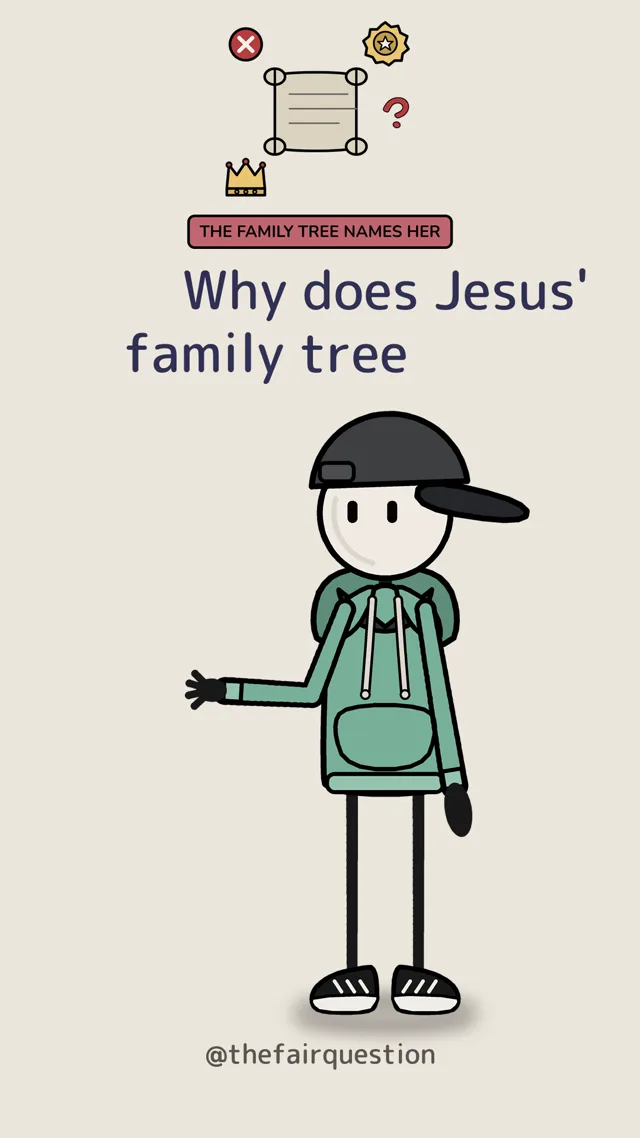
Why does Jesus’ family tree in Matthew 1 name a prostitute?
Matthew’s opening genealogy names four women before Mary — Tamar, Rahab, Ruth, and “her who had been Uriah’s wife” — in a list that otherwise runs father to son. What the four have in common is argued. What is not argued is that the list is not tidy, and that Matthew put it on page one rather than at the back.
The hard parts of the text · Reviewed
Also asked as Why is Rahab in Jesus’ genealogy? · Who are the women in Matthew 1? · Why does Jesus’ family tree name a prostitute?
The question
The New Testament opens with a genealogy: seventeen verses of who fathered whom, from Abraham to Jesus. It is the part most readers skip. Inside it, in a list that otherwise names only men, Matthew names four women. One of them, Rahab, is described elsewhere in the Bible with a single flat word: prostitute. Another, Bathsheba, is not given a name at all but identified as “her who had been Uriah’s wife,” which points directly at the worst thing King David ever did. Why would you open a book that way?
02 The objection — as its best advocate would put it
Three objections, and the second one is the good one.
One: this is a sermon point pretending to be a textual observation. Matthew’s genealogy is the most visibly constructed passage in the New Testament. He tells you so himself in verse 17: three sets of fourteen generations. And the arithmetic is achieved by leaving people out. Compare Matthew 1:8, where Joram fathers Uzziah, with 1 Chronicles 3:11–12, where three kings sit between them: Ahaziah, Joash and Amaziah. So this is a shaped document. Citing a shaped document as evidence of anyone’s honesty is a strange move. The four women are an author’s choice, not an awkward fact that survived editing.
Two: the four women do not have in common what they are said to have in common. Ruth is not a scandal. She is the heroine of her own book, praised in it as better than seven sons. Rahab is listed in Hebrews 11 among the examples of faith. Tamar is declared more righteous than the patriarch who condemned her, by that patriarch. To bundle four very different women under the heading “scandal” is to flatten three of them in order to make a point about the fourth, and it treats women’s presence in a list as inherently in need of explanation.
Three: it does not agree with the other one. Luke also gives a genealogy, and the two do not match. Matthew 1:16 names Joseph’s father as Jacob. Luke 3:23 names him as Heli. This has been a known problem for as long as there have been Christians, and any argument that leans on the honesty of Matthew’s list has to deal with the fact that it cannot both be right.
The answer
Take the objections in order, because answering them is the answer.
On the shaping. It is true, and Matthew is the one who tells you. Verse 17 states the three-times-fourteen structure openly, and the omissions are checkable against Chronicles by anyone with two open Bibles. But notice what follows from that, and what does not. It follows that Matthew is arranging. It does not follow that he is concealing, and arranging is the ordinary practice of ancient genealogy: these lists were built to say something about a person’s standing, not to satisfy a modern registrar.
Which makes the four names harder to explain away, not easier. If a man is arranging a list in order to make a point, and he is compressing it hard enough to drop three kings, then every name he keeps is a name he chose to keep. He had room to leave out anything he wanted. He kept these.
On what the four have in common. This is where the honest answer is more interesting than the popular one, and it involves conceding most of objection two.
Here are the four, with what the Bible actually says about each.
Tamar (Matthew 1:3). Genesis 38. She is widowed twice within Judah’s family, and Judah sends her home to her father’s house with a promise that his third son will marry her when he grows up, a promise he does not keep. She then covers her face and sits by the road; Genesis 38:15 says Judah “thought that she was a prostitute, for she had covered her face.” She was disguised, and what she was after was the family obligation owed to her. When it comes out, Judah’s own verdict is in Genesis 38:26: “She is more righteous than I, because I didn’t give her to Shelah, my son.”
Rahab (Matthew 1:5). Joshua 2:1 introduces her as “a prostitute whose name was Rahab,” without softening. Joshua 6:25 records that she and her household were spared. Hebrews 11:31 uses the same word again while listing her as an example of faith: “By faith, Rahab the prostitute, didn’t perish with those who were disobedient.” So the label is not an insinuation and it is not a modern reconstruction. It is the word three separate biblical books use.
Ruth (Matthew 1:5). A Moabite. That matters because Deuteronomy 23:3 says an Ammonite or a Moabite “shall not enter into Yahweh’s assembly; even to the tenth generation.” She is the great-grandmother of David (Ruth 4:17). She is also, on any reading of her own book, admirable, and objection two is right that calling her a scandal is a misreading.
”Her who had been Uriah’s wife” (Matthew 1:6). Matthew does not print Bathsheba’s name, though he prints the other three. He identifies her by her first husband, the man David had killed (2 Samuel 11:3; 2 Samuel 12:9). And the subject of the sentence is David. Whatever Matthew is doing there, he is not drawing attention to her.
So what is the shared feature? This is genuinely argued, and the main proposals are set out below rather than settled here. What can be said without picking a side is narrower and, once you see it, sufficient: three of the four are connected to episodes the family in question would have had reason not to raise, and the fourth is a foreigner whose inclusion required a legal problem to be gone around. None of the four is the kind of name a person adds to make a lineage look better.
On the claim that genealogies never name women. This one needs correcting, including where the correction cuts against our own shorthand. Biblical genealogies overwhelmingly run father to son, and that is the pattern Matthew is working in. But they are not absolutely without women. 1 Chronicles 2:4 names Tamar in exactly this connection: “Tamar his daughter-in-law bore him Perez and Zerah.” Matthew may simply be following the source. So the accurate statement is not “genealogies never name women, and Matthew broke the rule.” It is: the dominant convention is father to son, women appear rarely, Matthew includes four in sixteen verses, and the four he includes are not a random sample. That is a smaller claim and it is the one the evidence supports.
On the disagreement with Luke. It is real, it is old, and pretending otherwise would be exactly the failure this site exists to avoid. Matthew and Luke give different names for Joseph’s father and differ substantially through the generations between David and Joseph. Christians have proposed several explanations — that one traces legal descent and the other biological, that one is Mary’s line, that levirate marriage accounts for the split — and each has been argued and criticised for centuries. This page is not going to pick one, because the texts do not settle it. What can be said is that the difficulty was not discovered recently and was not hidden: both genealogies have sat in the same collection, four books apart, since the collection existed.
What is left, once all that is conceded. Matthew wrote an opening page for a book about a king. He had complete freedom over what to include, and he demonstrably used that freedom, because he compressed the list to fit a pattern. Into a document of that kind he put a woman Judah mistook for a prostitute, a woman three books call a prostitute, a woman from a nation the law barred, and a phrase that says “Uriah” out loud on the page where David is introduced as king. That is a choice, and it was made first, before anything else in the New Testament.
The scripture, in full
World English Bible · Public domain
Matthew 1:1–6
The book of the genealogy of Jesus Christ, the son of David, the son of Abraham.
Abraham became the father of Isaac. Isaac became the father of Jacob. Jacob became the father of Judah and his brothers. Judah became the father of Perez and Zerah by Tamar. Perez became the father of Hezron. Hezron became the father of Ram. Ram became the father of Amminadab. Amminadab became the father of Nahshon. Nahshon became the father of Salmon. Salmon became the father of Boaz by Rahab. Boaz became the father of Obed by Ruth. Obed became the father of Jesse. Jesse became the father of King David. David became the father of Solomon by her who had been Uriah’s wife.
Matthew 1:17
So all the generations from Abraham to David are fourteen generations; from David to the exile to Babylon fourteen generations; and from the carrying away to Babylon to the Christ, fourteen generations.
Genesis 38:14–15
She took off her the garments of her widowhood, and covered herself with her veil, and wrapped herself, and sat in the gate of Enaim, which is by the way to Timnah; for she saw that Shelah was grown up, and she wasn’t given to him as a wife. When Judah saw her, he thought that she was a prostitute, for she had covered her face.
Genesis 38:26
Judah acknowledged them, and said, “She is more righteous than I, because I didn’t give her to Shelah, my son.” He knew her again no more.
Joshua 2:1
Joshua the son of Nun secretly sent two men out of Shittim as spies, saying, “Go, view the land, including Jericho.” They went and came into the house of a prostitute whose name was Rahab, and slept there.
Hebrews 11:31
By faith, Rahab the prostitute, didn’t perish with those who were disobedient, having received the spies in peace.
Deuteronomy 23:3
An Ammonite or a Moabite shall not enter into Yahweh’s assembly; even to the tenth generation shall no one belonging to them enter into Yahweh’s assembly forever;
Where Christians disagree
What the four women have in common
There is no settled answer, and readers should know the field. One long-standing reading is that all four are associated with sexual irregularity of some kind, whether their own doing or done to them. A second is that the common thread is foreignness: Rahab is a Canaanite, Ruth a Moabite, Bathsheba is identified through a Hittite husband, and Tamar’s story is set among Canaanites. A third is that each of the four acted decisively in a situation where the men around them had failed, and that Matthew is preparing the reader for a fifth woman in an irregular situation at verse 16. These readings are not all mutually exclusive and each has serious support. This page does not choose between them, because Matthew states no reason at all.
Whether Mary belongs in the group
Mary is named in Matthew 1:16 and most readers treat her separately, as the person the list arrives at rather than as one of its irregular entries. Some read her as the fifth member of the pattern. That is a reading, not a fact, and it is worth flagging as such.
How to reconcile Matthew’s genealogy with Luke’s
Set out above. Several explanations are held by Christians in good standing; none commands agreement.
Whether the omissions are a problem
Some hold that ancient genealogies simply worked this way and no claim of completeness is being made or broken. Others treat the compression as a difficulty requiring explanation. Both positions exist inside traditions that hold a high view of Scripture.
What the text does not tell us
Matthew gives no reason for including any of the four. Not one sentence of comment, no aside, no “and note that.” He puts the names in and moves on. Every explanation above, including the ones we find persuasive, is a reader’s inference.
He does not tell us why Bathsheba alone goes unnamed. It is a striking difference and it is not explained.
Genesis does not tell us what Tamar intended beyond what the narrative shows, and it does not say she was a prostitute — it says Judah thought so, because her face was covered.
And the genealogies do not tell us how they relate to each other. Matthew does not mention Luke’s list and Luke does not mention Matthew’s.
In one paragraph
The New Testament opens with a genealogy that runs father to son, and Matthew breaks that pattern four times before reaching Mary: Tamar, Rahab, Ruth, and “her who had been Uriah’s wife.” He is not compiling a public record — he tells you in verse 17 that he has arranged the list in three sets of fourteen, and comparing Matthew 1:8 with 1 Chronicles 3 shows he dropped three kings to do it. Which means every name that stayed is a name he wanted. What the four women have in common is genuinely argued: sexual irregularity, foreign origin, and decisive action in a failure of the men around them have all been proposed, and Matthew gives no reason himself. What is not in dispute is that a man building an opening page for a king’s biography, with total freedom over what to include, chose to include these.
The video came first. This page is the part that did not fit.
You have just read the whole answer. The 52-second version of it goes up on the channel on 24 August 2026; nothing here is waiting on that.
A 52-second version exists and has no date yet. The episode list carries the schedule.
thefairquestion.com/questions/women-in-jesus-genealogy-matthew-1/ · Reviewed 2026-07-30 · Scripture: World English Bible, public domain