Reviewed
Does the Bible really say an eye for an eye? And did Jesus contradict it?
The formula appears three times in the law and every time it sits inside a courtroom, with judges named before or around it. It fixes a penalty at the size of the injury, which caps revenge and also blocks leniency. Jesus quotes it and goes further, addressing personal retaliation. Whether that repeals the judicial rule is where Christians have divided for centuries.
Verses everyone quotes wrong · Reviewed
Also asked as What does “an eye for an eye” mean? · Did Jesus contradict an eye for an eye? · Is “an eye for an eye” still in the Bible?
The question
“An eye for an eye, a tooth for a tooth” is the phrase people reach for when they want to describe primitive justice. It is in the Bible three times. Christians usually respond that it was actually a limit on revenge rather than a licence for it. Is that true, or is it damage control?
02 The objection — as its best advocate would put it
The “it was a limit” answer deserves a hard look, because it is suspiciously convenient.
Read the text. Exodus 21:24 does not say “no more than an eye for an eye.” It says “eye for eye, tooth for tooth, hand for hand, foot for foot.” Leviticus 24:20 says “as he has injured someone, so shall it be done to him.” Deuteronomy 19:21 adds a line that is very hard to read as restraint: “Your eyes shall not pity: life for life, eye for eye, tooth for tooth.” Your eyes shall not pity. That is not the vocabulary of mercy being introduced into a violent world. It is the vocabulary of a judge being told not to go soft.
So the “ceiling” reading is a modern reader’s method for keeping a text they would otherwise have to disown. It lets you admire the passage without owning the sentence.
And then there is the second problem, which the first answer creates. In Matthew 5, Jesus quotes this formula and says the opposite. Either he is correcting a law the same religion says God gave — in which case the law was not good, and the ceiling defence was unnecessary — or he is performing a rhetorical move on his own scriptures that any other teacher would be criticised for. You cannot simultaneously argue that the Old Testament law was humane and that Jesus had to replace it.
The answer
Start by putting all three occurrences on the table, because the argument turns on where they sit rather than on what they say.
Occurrence one: Exodus 21:22–25. The formula appears at the end of a case about men fighting and injuring a pregnant woman. Look at what precedes it. Verse 22: “he shall be surely fined as much as the woman’s husband demands and the judges allow.” Judges are in the frame before the formula arrives.
Occurrence two: Leviticus 24:19–20. “If anyone injures his neighbor; as he has done, so shall it be done to him: fracture for fracture, eye for eye, tooth for tooth.” A rule of sentencing, in a passage that has just described a case being brought and a ruling given.
Occurrence three: Deuteronomy 19:18–21. The clearest of the three, and the one the objection quotes. Read the whole unit. Verse 18: “and the judges shall make diligent inquisition: and behold, if the witness is a false witness, and has testified falsely against his brother; then you shall do to him as he had thought to do to his brother.” The case is perjury. The judges are conducting the inquiry. The formula is the sentence they hand down.
So in all three places the formula is addressed to a court, not to a victim. That is not an inference from outside the text; it is the immediate literary frame in each instance. Nothing here gives an injured person a right to go and take an eye. It tells a tribunal what the penalty is.
Now, is that a “limit”?
Here is where the honest version differs from the popular one, and it is worth correcting our own shorthand. Calling it purely a ceiling is not quite right, and Deuteronomy 19:21 is the reason. “Your eyes shall not pity” is addressed to the judges, in a case of deliberate perjury, and it forbids leniency. The formula does not only stop a court over-punishing; it also stops a court under-punishing.
The accurate description is that it fixes the penalty at the size of the injury, and fixing cuts both ways: you cannot charge more, and you cannot let someone off because of who they are. That is a constraint on the powerful in both directions — it stops a rich man buying his way out and a mob taking more than the wrong was worth. It is a stronger claim than “a limit on revenge,” and it accounts for the verse the objection correctly identifies as awkward.
The world it enters. Two chapters into the Bible’s first book, before any law exists, Genesis 4:23–24 records Lamech’s song to his wives: “for I have slain a man for wounding me, a young man for bruising me. If Cain will be avenged seven times, truly Lamech seventy-seven times.” A wound repaid with a death, and boasted about in verse. That is the escalation the formula addresses. Against unlimited private vengeance, proportionality is a restraint whether or not the word “only” appears. A rule that sets the price at X is, by construction, a rule against charging 2X.
Was it ever carried out literally? This is the question everyone asks, and it deserves a careful answer rather than a confident one.
What can be said from the text: the same chapter that contains the formula also contains Exodus 21:26–27. “If a man strikes his servant’s eye, or his maid’s eye, and destroys it, he shall let him go free for his eye’s sake. If he strikes out his male servant’s tooth … he shall let him go free for his tooth’s sake.” Eye and tooth again, two verses after “eye for eye, tooth for tooth” — and the remedy is not the offender’s eye. It is freedom for the injured person. So the legislation immediately around the formula does not treat mirror-image mutilation as the only available response to a destroyed eye.
What cannot be said: this page will not tell you the penalties were never literal. The Old Testament does not narrate a court carrying one out, and an absence of narration is an argument from silence, which is worth labelling as such. The nearest thing is Judges 1:6–7, where Adoni-Bezek has his thumbs and big toes cut off and says, “As I have done, so God has done to me” — but that is a battlefield, not a tribunal applying Exodus 21.
This page also makes no claim, in either direction, about how these rules compare with other legal codes of the ancient world. That comparison is made confidently by people arguing both sides, and none of the argument above depends on it.
Then Jesus. Matthew 5:38–39: “You have heard that it was said, ‘An eye for an eye, and a tooth for a tooth.’ But I tell you, don’t resist him who is evil; but whoever strikes you on your right cheek, turn to him the other also.”
Three observations, and the third is the important one.
First, notice what he does not say. He does not call the law unjust, cruel or mistaken. He quotes it and moves past it. This page will not put “he corrected it” in his mouth, because the text does not say that.
Second, notice the subject. The examples that follow are personal: a slap, a lawsuit over a coat, being compelled to walk a mile, someone asking to borrow. These are situations an individual is in, not rulings a magistrate makes. The formula in Exodus and Deuteronomy is addressed to judges; the sentences in Matthew 5 are addressed to the person who was hit. Whether that is a change of subject or a change of rule is precisely the point of disagreement below.
Third, notice the pattern of the whole passage. This is one of six sayings in the same shape. In the first of them, Matthew 5:21–22, he quotes “You shall not murder” and then extends it inward, to being angry with your brother and to what you call him. That is plainly an intensification, not a repeal. The pattern of the section is escalation. Whatever verse 39 is doing, it is doing it in a series where the direction of travel is more, not less.
One popular detail is worth flagging as an inference. Many readers point out that a blow to the right cheek from a right-handed person would be a backhand, and so an insult rather than an assault. It is reasonable. The text does not say it, and nothing above depends on it.
The scripture, in full
World English Bible · Public domain
Exodus 21:22–27
“If men fight and hurt a pregnant woman so that she gives birth prematurely, and yet no harm follows, he shall be surely fined as much as the woman’s husband demands and the judges allow. But if any harm follows, then you must take life for life, eye for eye, tooth for tooth, hand for hand, foot for foot, burning for burning, wound for wound, and bruise for bruise.
“If a man strikes his servant’s eye, or his maid’s eye, and destroys it, he shall let him go free for his eye’s sake. If he strikes out his male servant’s tooth, or his female servant’s tooth, he shall let him go free for his tooth’s sake.
Leviticus 24:19–20
If anyone injures his neighbor; as he has done, so shall it be done to him: fracture for fracture, eye for eye, tooth for tooth; as he has injured someone, so shall it be done to him.
Deuteronomy 19:18–21
and the judges shall make diligent inquisition: and behold, if the witness is a false witness, and has testified falsely against his brother; then you shall do to him as he had thought to do to his brother. So you shall remove the evil from among you. Those who remain shall hear, and fear, and will never again commit any such evil among you. Your eyes shall not pity: life for life, eye for eye, tooth for tooth, hand for hand, foot for foot.
Genesis 4:23–24
Lamech said to his wives, “Adah and Zillah, hear my voice. You wives of Lamech, listen to my speech, for I have slain a man for wounding me, a young man for bruising me. If Cain will be avenged seven times, truly Lamech seventy-seven times.”
Matthew 5:38–42
“You have heard that it was said, ‘An eye for an eye, and a tooth for a tooth.’ But I tell you, don’t resist him who is evil; but whoever strikes you on your right cheek, turn to him the other also. If anyone sues you to take away your coat, let him have your cloak also. Whoever compels you to go one mile, go with him two. Give to him who asks you, and don’t turn away him who desires to borrow from you.”
Where Christians disagree
How far Matthew 5:39 reaches
This is one of the oldest and most consequential disagreements in Christian history, and it is not close to settled. The historic peace churches — Anabaptist traditions including Mennonites and the Amish, and the Quakers — read “don’t resist him who is evil” as a comprehensive renunciation of violence, binding on Christians as individuals and as communities, including in matters most people would call self-defence or law enforcement. On this reading Jesus is not narrowing the scope of the old rule; he is setting it aside for his followers. Most other traditions, Catholic, Orthodox, Lutheran, Reformed and Anglican among them, distinguish between personal retaliation and the responsibilities of public authority. They point to Romans 12:17–19, which forbids private revenge in the strongest terms, sitting a few sentences before Romans 13:4, which says the civil authority “doesn’t bear the sword in vain.” On this reading Matthew 5 governs how you respond to being wronged, and it does not abolish courts. Both readings are old, both have produced people who died for them, and both are working from the same paragraph. This page does not adjudicate between them.
Whether the Mosaic penalties were literal or standard compensation
Some hold that monetary compensation was the ordinary application, pointing to the fine in Exodus 21:22 and the freedom granted in 21:26–27. Others hold the formula meant what it said and functioned as a maximum a court could impose. The texts permit both readings.
How the Mosaic law relates to Christians at all
Some traditions distinguish moral, civil and ceremonial categories within the law and treat only the first as continuing. Others regard that division as a later framework imposed on a text that does not use it. This affects the whole question and is itself disputed.
What the text does not tell us
Whether any court ever carried out a mirror penalty. No such case is narrated in the Old Testament. That is an argument from silence and is presented here as one, not as proof.
How courts actually operated. The law gives rules. It does not give us case reports, and we have no record of how judges in ancient Israel applied these particular provisions day to day.
What Jesus would say to a judge. Matthew 5 addresses individuals about their own responses. It contains no instruction to a magistrate, and both sides of the disagreement above have to reason from silence to get one.
Why “your eyes shall not pity” is in Deuteronomy and not in Exodus or Leviticus. The three passages differ in wording and setting, and none of them explains the others.
In one paragraph
“Eye for an eye” appears three times in the law, and every time it is addressed to a court. Exodus puts the judges in the sentence before it. Deuteronomy puts it at the end of a perjury trial the judges are conducting. It fixes a penalty at the size of the injury, which caps revenge and also blocks leniency, and it enters a world whose opening picture of vengeance is Lamech killing a man for a bruise and setting it to music. Two verses after the formula, Exodus deals with a destroyed eye by freeing the injured person rather than blinding the offender, which suggests the legislation itself did not treat mirror-image mutilation as the only remedy — though the Old Testament never narrates a court applying the rule either way, and that silence proves nothing on its own. Jesus quotes the formula and goes further, addressing people about their own response to being struck rather than telling a court what to do. Whether that ends the judicial rule or sits alongside it is the point Christians have divided over for centuries, and this page does not pretend to settle it.
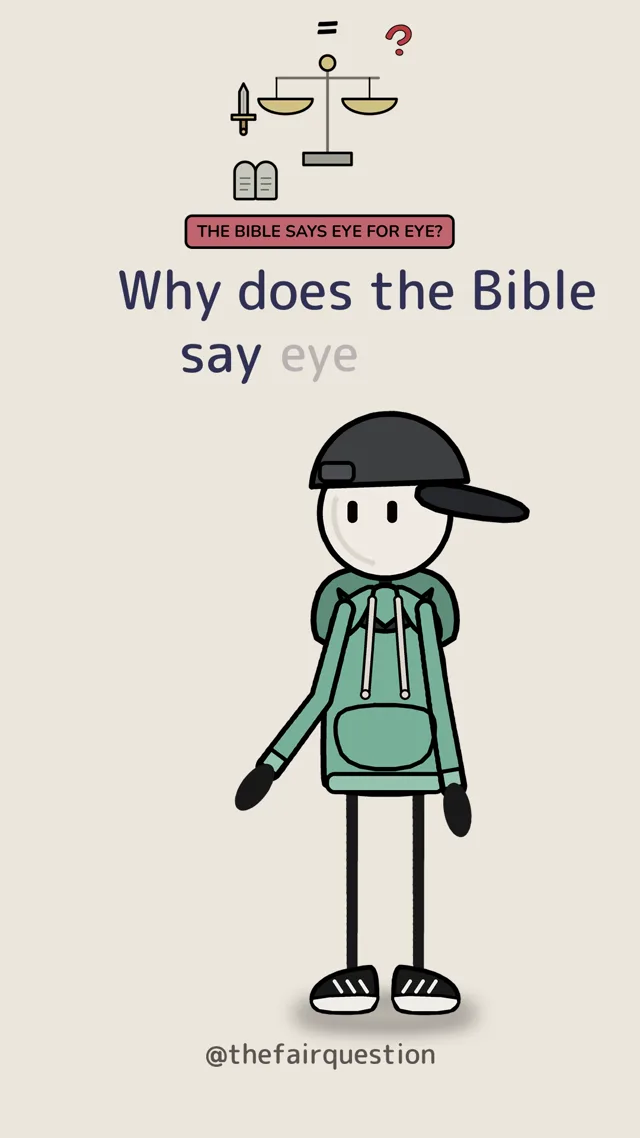
The video came first. This page is the part that did not fit.
You have just read the whole answer. The 51-second version of it goes up on the channel on 27 August 2026; nothing here is waiting on that.
A 51-second version exists and has no date yet. The episode list carries the schedule.
thefairquestion.com/questions/what-does-an-eye-for-an-eye-mean/ · Reviewed 2026-07-30 · Scripture: World English Bible, public domain